FOOD POLICY: COUNTERING INDUSTRY INTERFERENCE TOWARDS SECURING EVIDENCE-BASED CURBING of NCDS PREVALENCE IN CAMEROON

On November 25 and 26, 2025, marked a very important step in RADA’s and its partners advocacy for the adoption of a healthy food policy in Cameroon. The session titled “Food Policy: Countering Industry Interference towards Securing Evidence-Based Curbing of NCDs Prevalence in Cameroon” was geared towards
- Conducting a landscape analysis for industry interference on Front of Package Warning Labels (FOPWL) and Taxation Policies in Cameroon.
- Conduct a political mapping of the industry
- Contribute to the Industry interference response strategy
The host for the day was Ms. Chenwi Claris introduced the organization and handed the floor to Ferdinant M. Sonyuy to provide opening remarks. After welcoming the participants, he stated that the session would focus on political mapping and that it would be conducted with a strong understanding of policy advocacy to achieve the session's objectives.
With the aim for the session known to the participants, Ferdinant defined what NCDs are and their risk factors, as well as the global picture, the Cameroon situation. He went further to talk about what unhealthy diets are and their link to NCDs and the consequences, especially in children and young adults. In the next phase, he discussed mitigation strategies, including taxation, FoPWLs, and regulation of advertising, among others. There was also a presentation on what Front of Package Warning Labels (FoPWLs) are. the FoPWLs that RADA designed in collaboration with MINSANTE and the research methodology. The highlight of the policy pathways for both the FoPWLs and taxation of unhealthy diets was given. The objectives of the presentation were;
- To understand the industry interference and the landscape of the FoPWLs and Taxation policies.
- To conduct a political mapping of industry interference on the two food policies.
- Contribute to the industry interference response strategy and collaboration


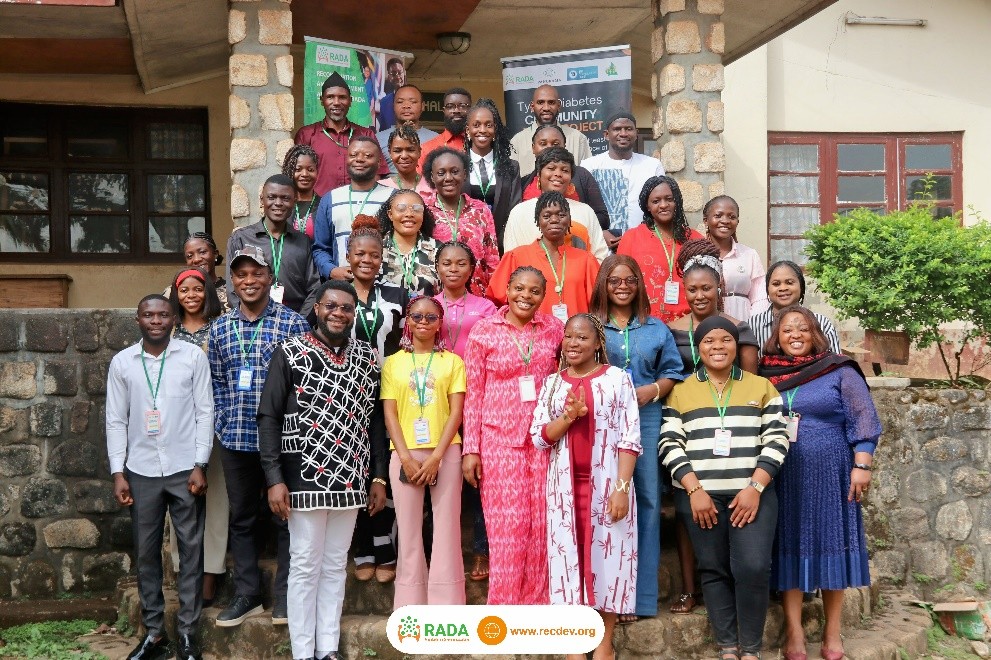
A family photo was taken, which was closely followed by a breakout session. The participants were split into two groups, which focused on FoPWLs and the Taxation of unhealthy Packaged Foods, respectively. They had to follow a presentation, then participate in the group work sessions.
Ferdinant presented on industry interference and mapping, where he defined industry interference and gave the reason for mapping, which is that we want to be 80% proactive towards interference and 20% reactive (20/80 rule). He also presented the advocacy strategy and the industry strategy for both the FoPLWs and the Taxation of Unhealthy Packaged Products. He also enumerated the various analyses that were done and their importance. Ferdinant also presented the industry landscape analysis, which started from the problem to the strategy.
“The point is to have a situation where industry is neutralized in the advocacy process, and the policies passed”. Mentioning the actors and actions, the results from the RADA Industry Interference Monitoring Response and Orientation Platform (RIIMROP) site on industry actions showed a high level of actions from the industry.
The four (4) elements of monitoring are the purpose of monitoring, what to monitor, how to monitor, and the tools and methodologies for monitoring. There are 3 levels of actors: multinational, business platforms, and alliances established by levels one and two. He presented an iceberg of industry, which included three parts, with the top being industry interference actions to oppose/influence policies, the food industry taxonomy was next under the water, and trends to achieve and ensure co-governance were the bottom of the iceberg. He spoke about political action, which was the main target of the working session. This process involves actions targeted at decision makers, policy processes, and opposition viewpoints to reduce or counter industry interference. So, there is a need to map out the process, identify the key decision makers, map key influencers and external stakeholders, and assess the decision makers, key influencers, and stakeholders.
Day 2 followed a similar pattern, as it was mostly characterized by group work, presentations, and recommendations to mitigate industry interference.
Overall, this 2-day workshop was a huge success, as the appraisals were positive and with key recommendations given to improve RADA’s advocacy for the adoption of healthy food policies in Cameroon. The workshop had over 10 participants in attendance, with representatives from the regional delegation of trade and mines, industry, and technological development, Civil society organizations, lawyers, Political Scientists, economists, and RADA.