Way-In Nkwen, Bamenda, Cameroon

RADA features in One Young World News!

In the midst of new challenges, OYW Ambassadors continue to display leadership and innovation in their communities. Among Ambassadors who have launched new initiatives, the CEO of RADA has featured in two main weekly articles of One Young World.

The first being the Community mutual Aid crisis response initiative, linking those in need of assistance with volunteers who want to assist, and the second being his role in a Youth Webinar

Find the links to the publications below:

Community Mutual Aide Crisis Response: HERE

Session 2: The Future is Now! Youth, NCDs, and the COVID-19 Pandemic organized by the CORE Group NCDs Interest Group- HERE

CORE Group Webinar on Youth Focused NCD Accountability Frameworks – HERE

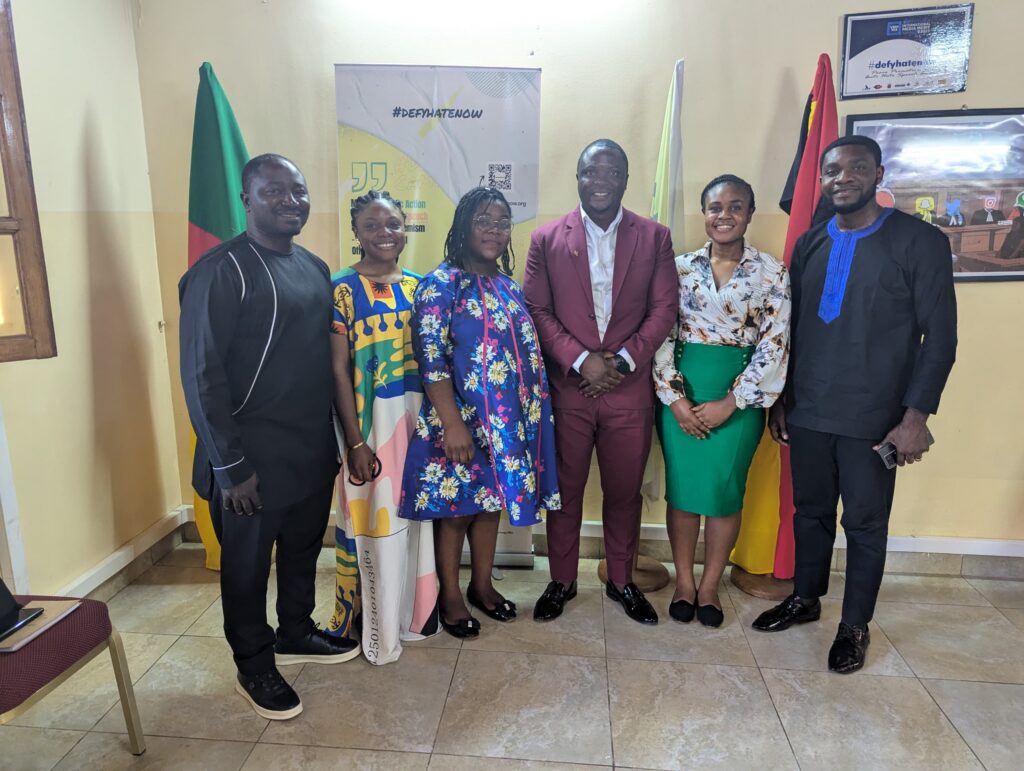
The team behind the scenes of all the work done in RADA in planning session

RADA in Collaboration with the Cameroon CS NCD Alliance organizes Panel Discussion and Press Briefing

SUMMARY OF MESSAGES:

  • We all are accountable for our actions and responsible for our environment through good policies.
  • Preventing NCDs makes perfect economic sense.
  • NCDs are slow in progression, a silent pandemic. NCDs kill and everyone is at risk.
  • It’s our duty to sensitize the public on the existence and dangers of NCDs and their risk factors
  • NCDs are a leading cause of poverty in many countries and should be prioritized in ours too.
Nessa Mbatu, Ferdinant M. and Claudette N.

The global week for Action on NCDs is aimed at reawakening people on the presence of NCDs. The action week is in its third year and the theme for this year was ACCOUNTABILITY. RADA Cameroon in collaboration with the Cameroon NCD Alliance, organized a panel discussion\media briefing amidst several other activities under the umbrella national theme “Raising Attention, Promoting Accountability on NCDs at local and national levels in Cameroon”.

This panel discussion was to inform and educate the public on NCDs through the media.  This event was attended by a total number of 35 persons, with 13 media houses represented to cover the event. The panel discussion started at 10:30am. This was a late start due to the power failure which hindered the early start of the discussion. The panelist on board for the discussion where, Mr.Ferdinant Mbiydzenyuy the CEO of RADA/SG of the Alliance, Madam Claudette the North West Delegation of Health, Focal Person for NCDs , Madame Relindis, the Chief of Bureau Health for the Health District and  Madame Mbatu Nessah a youth advocate and representative from Value Health Africa. The Panel was moderated by Irene Mofor, a young Advocate for NCDs.  The panelist present for the discussion were of diverse backgrounds so as to be able to answer the certain question form their various field of understanding. Due to the crisis that was prevailing in the region, the person living with NCDs who was invited to the panel was unable to get a taxi to arrive on time. Also, the Person living with Kidney Disease who is a Journalist and was invited to moderate, was unable to come as she was unwell.  

Recommendations by/To RADA and the CACSNA after the session:

  • Youths should take up the responsibility to go out in to the public and sensitize the people on the risks associated with NCDs, the various risk factors and how to manage and control them.
  • Government should implement a policy ban on the sales of tobacco, sweet drinks and alcohol especially in student environments.
  • There should be an improvement in specialty care given to persons living with cancer, stroke, diabetes and NCDs in general.
  • RADA should come up with programs that will help facilitate the fight against NCDs in the country.
  • As individuals, it is our duty to be aware of the existence of NCDs and work to prevent and control it.
Cross Section of Staff of RADA

To conclude, we all know that NCDs are not Human friendly and they are not biased they do not look at how rich you are or how poor you are nor do they look at how tall and short you are. They affect each and every one of us. Statistics shows that we are truly living in a generation that is more likely to die before their parents due to the risk of NCDs.  So, we have to take action right now to fight against the spread of NCDs. Let stand together and fight this common cause in other to save our future generations to come. Health is wealth.

A detailed report with speakers specific comments to Media is here:

IMPORTANT Advisory Note: Travelers in the English Speaking Regions of Cameroon

ALL TRAVELING TO BAMENDA, AND THE NORTHWEST AND SOUTHWEST IN GENERAL ARE STRONGLY ADVISED TO TAKE NOTE OF THE FOLLOWING:

  1. For your own good, whenever law enforcement agents ( whether in uniform or not) stop a vehicle you boarded, stay calm, avoid hissing and grumbling. Whether you are a man or a woman,
    respect them.
  2. Please take the receipts of your electronic equipment, laptop or other bulk gadgets (original or photocopy), anywhere you go if you must carry them.
  3. If you don’t have means of identification from your school or workplace, get at least a national ID card or driver’s license. It is crucial. your professional Badge may also help u at the military control. But be careful with it at the other type of control. U know u know.
  4. Delete all your bank alerts, and transfer sensitive information into a flash drive or memory card. Keep your financial transactions away from your phone.
  5. Carrying more than one ATM card may bring serious problem for you in our present-day Northwest especially with the other type of control: be warned !!!
  6. If you must move at night no matter how close to your house, take your ID card and let someone go with you.
  7. Dress responsibly – it will save you. Looking rugged and wild may earn you serious trouble. Take care of your hairstyle.
  8. If you are given a vehicle to go for an errand, make sure all documents are complete and up- to- date. Also, your driver’s licence must be complete before you hit the road.
  9. When your car is being searched, don’t just look away in anger ; they are doing their job. Just
    pay close attention to what’s going on, to avoid “had I known”.
  10. If you are not sure of what someone is carrying in a bag, pack, or sack, please ask politely before accepting to give the person a ride. You may be arrested for what you know nothing about.
  11. After any stranger you decide to give a lift comes down, move forward a little, park and search your vehicle very well before you continue so as to avoid harboring any incriminating objects left behind.
  12. It is mandatory necessary you don’t keep this message to yourself alone.

13) Be patient when traveling. Being in a haste may land you into serious problems. Where you find vehicles parked and are waiting, seek advise. You may not know the trap ahead

14) You will fine multiple controls from Matazem, Santa, welcome to Bamenda, Blue moon, mile one junction, Tradex etc before you enter town. Do not complain. They are working on instructions. You will be asked to drop down and identify yourself. Your car will be searched at these spots. They will take all your time. But do not complain.

15) Be aware that there is operation Bamenda Clean involving all men in uniform and the population. Don’t be frightened in the quarter when u see a group of millitary.

16) Above all avoid certain talks because even those people you think you know them, you don’t really know them in details. Be vigilant and Stay safe.

This note was copied and modified from a circulated message. It is endorsed as an Advisory to those traveling in the NW/SW regions of Cameroon.

Thank you.

Singed:

Ferdinant M. SOnyuy
President, RADA.

Statement by the Reconciliation and Development Association during the Week for Action on NCDs, from September 7-13, 2020 on Accountability

Brief Background:

Non-communicable Diseases (NCDs) are silent killers. Non transmissible from person to person unlike COVID-19, and are driven largely by four main modifiable risk factors – tobacco use (cigarette smoking), unhealthy diet (excessive fasts and sugar), physical inactivity (overweight or fat deposits), and harmful use of alcohol.

Some of these diseases include; cardiovascular diseases which accounts’ for most NCD deaths, or 17.9 million people annually, followed by cancers (9.0 million), respiratory diseases (3.9 million), and diabetes (1.6 million). In 2018, the United Nations High Level Meeting on non-communicable disease added Mental Health and Pollution resulting in a 5 by 5 framework approach to preventing NCDs. Each year, NCDs account for 41 million deaths globally, with 85% coming from the low- and middle-income countries.  35% of annual deaths in Cameroon are due to NCDs.

Given the current COVID-19 pandemic, persons living with NCDs have been provide to have highest risks of severe outcomes. About 80% of COVID-19 deaths are recorded with persons living with NCDs. We’ve seen through COVID-19, the devastating effects of inattention to certain groups of our population providing universal health coverage. We also need to build our health system to be ready to respond to crisis comprehensively. NCDs are a major cause (and consequence) of poverty and a barrier to economic and social development.

 “Investing in population health to solve the problem of NCDs makes economic sense” – Prof. Jean Claude Mbanya, Chair, Cameroon NCD Alliance

The ActOnNCDs Campaign:

We have made plans, promises, and political signatures on global goals as well as commitments to fight against NCDs.  It’s time to keep these promises by Acting on issues related to NCDs.  The Global Week for Action on NCDs is in its third year. Each year, it is conducted to raise a voice for NCDs. For 2020, under the theme «ACCOUNTABILITY” the Week of Action aims at reawakening people on the dangers of NCDs as well as unite the NCD movement to recognize that accountability is not just in finances, but also in what we promise to do. Accountability is a crucial force for political and programmatic changes that will reduce the NCD burden of NCDs not just in Cameroon, but globally, improving the health of the population.

As RADA, we are affirm that community development is incumbent on a healthy society, hence, call on health, trade, finance, agriculture and other sectors of both government and the society to give heed to the benefits of investing on a healthy workforce and population by Acting on NCDs where their responsibility lies.  

Actions such as those below are essential:

  1. We need to ban sales of alcohol to youth and children below 18 years of age.
  2. Tax unhealthy products such as (high sugar and fatty content foods)
  3. Educate on moderation and appropriate feeding by the population.
  4. Continue to promote physical activity
  5. Ban the illegal sales of tobacco and drugs such as tramadol.
  6. Promote an end to conflicts that inflict mental health stress, pain and suffering

OUR ROLE AS RADA

As a member of the Cameroon Civil Society Non Communicable Disease Alliance, we are running a National Youth NCD Action Network to raise awareness among youths, and support them towards walking the talk on NCDs. We add our voice to the efforts being made by the government as well as the entire NCD community in Cameroon to increase access to care for persons living with NCDs and re-iterate that more specific interventions needs to be implemented.  

Together with the Alliance, RADA is ready to support, partner and collaborate with stakeholders to accelerate the implementation of national commitments on NCDs and Universal Health Coverage towards the fulfilment meaningful community development.

Thank you.

Ferdinant M. Sonyuy
President/CEO, RADA.

About RADA :

RADA is a community development organization based in Bamenda. Our mission is to promote community development by building bridges to sustainable solutions in the domains of health, education, agriculture, technology and peace. More about RADA on www.recdev.org

Tweet Chat with Food and Genes Initiative

“Acting on NCDs must start from understanding the root causes that lead to NCDs” Samuel Ogunsola; CEO of Food and Genes Initiative, Nigeria.

To mark the NCDs week this year, we are delighted that in collaboration with the Food and Genes initiative, the CEO of RADA will be facilitating a tweet chats on the risk factors responsible for NCDs.

The link is www.twitter.com/foodandgenes

Also follow RADA on twitter at: @Recdefcameroon.

Global Week of Action on NCDs- 2020: Raising Attention, Promoting Accountability on NCDs at Local and National levels in Cameroon

Theme-2020: Accountability

What is the Global Week of Action for NCDs?

NCDs are currently the #1 cause of death and disability in the world, and the burden is disproportionately severe in low- and middle-income countries, where four out of five people with an NCD live. The Global Week for Action on NCDs is organized by the NCD Alliance global and aims to unite the NCD movement each year under a specific theme, concentrating our combined efforts with the aim of reducing the NCD burden globally and increasing health and equality. Join the movement!

Under the banner of “Raising Attention, Promoting Accountability on NCDs at Local and National levels in Cameroon” The Cameroon CS NCD Alliance will be mounting the national stage with activities to raise awareness on NCDs and the need for accountability regarding desired prevention and control SDG targets. The theme for this year’s Week of Action on NCDs is “Accountability”. Activities will put persons living with NCDs at the center of essence for the Week’s action.  

  1. Social Media Activities by all members
  2. Inclusive games at the Baptist Center by CBCHS
  3. Advocacy visits to Mayor, and MoH by CBCHS
  4. Radio Talk shows by CBCHS, RADA, and C3T
  5. Panel Discussion by RADA
  6. Tweet Chats  by RADA
  7. Interactive online Q&A on NCDs by RADA
  8. Zoom Conference – in Collaboration with CORE Group by RADA
  9. Patient meeting – by CBCHS
  10. Press briefing /Conference  by RADA and C3t
  11. Health Talks in Churches  by CBCHS
  12. Publication of statements by all members
  13. NCD Tracts sharing at a Major market by C3t
  14. Zoom Webinar by Rural Doctors

                          See the full time table of Activities below and dates to participate.

SN Activity Dates Organization(s) i/c
1 Disseminate messages on social media
(Contribute to ‘Voices of Change’; Share ‘Voices of Change’ quotes,
champion quote cards, info graphics, video messages or key messages through
social media using the harsh tag, #ActOnNCDs.)
September 7-13). All Member
organizations
2 Organise inclusive fun games at the Baptist Centre in Bamenda Saturday, September 12  CBCHS
3 Local Council Advocacy visit September
9
CBCHS
4 Visit to the radio for a Radio program (Radio Talk with Young NCD Advocates) September 8/September CBCHS/RADA
5 Organise
a meeting with Cancer Survivors in view of charting a path for the creation
of Patient Advocacy Group for Persons living with cancer and Survivors of
cancer
 
  CBCHS
6 Publish campaign activities on member
newsletters including the “NCD Voice Newsletter” and “Radates” are in view. 
September 13- 14th CBCHS/RADA
7 Health Talks in
Churches 
September 13 CBCHS
8 Statements from member organizations
will be issued on media  (All
Associations) 
Full Week All Members
9 The
Alliance will also issue a Statement on media  on the global Campaign
September
9th – 13th
CACSNA
Secretariat
10 Sensitization
campaign through traditional media including Magic FM, Radio Tiemeni
Siantou(RTS), The Post and Le Messager 
September 7-13th C3T,
11 Field visit with
Media, CACSNA Team members in Yde, PLWNCD to sensitize population on the
various NCDs followed by the distribution of hydro-alcoholic gels and Flyers
on NCDs at Mvan neighbourhood at the level of travel agencies.
 September 8th 2020 at 14 Pm C3t
12

Two 2- Advocacy visit
to the authorities:
Le Sous
Directeur de la lutte contre les MNTsLe
Directeur de la Promotion de la Santé ou Sous Directeur de la Santé MentaleDélégué
régional de la Santé Publique pour le Centre

(We encourage members in Yde to partake
N.B use your masks along).

September 10-11, 2020 C3t
13 Panel
discussion/ Press Conference, to discuss the problem of NCDs, the Alliance’s
work on NCDs in collaboration with other partners that will be present in Bamenda
and possibly, Yaoundé. (RADA,).
Topic:
“Accountability on NCDs”
Friday 11th RADA
14 Zoom
Webinar with CORE Group partners: “Youth Leaders Taking Action:
Developing an NCDs-Focused Accountability Framework.”
Sept. 9,
2020
RADA
15 Tweet
Chart with Nigerian Partners
September
7, 2020
RADA
16 Online
Interactive Session on “Accountability on NCDs” with RADA CEO.
Sept. 13,
2020
RADA
17 Zoom conference for health care
providers in rural areas to discuss their experiences and current actions
taken by stakeholders in supporting persons living with NCDs in the context
of COVID-19
TBD Rural
Doctors

About the Theme of 2020

Governments have committed to many NCD targets through the United Nations (UN), such as World Health Organization (WHO) NCD targets and the Sustainable Development Goals (SDGs). Accountability mechanisms for NCDs that are currenetly in place can be strengthened by independent civil society-led action, especially at the local and national level. We can all help ensure that commitments made translate into targets met, to turn back the tide on the current NCD epidemic. We’ve seen through COVID-19 the devastating effects of neglect – it’s time to stop making the same mistake with NCDs!- from trade to livelihoods and ultimately, development.
(Adapted from NCDA website).

CEO of RADA Gets Elected as SG of CACSNA!

We are delighted to announce that The CEO of RADA, Ferdinant M. Sonyuy was elected and officially assumed the role of Secretary General of the Cameroon Civil Society NCD Alliance (CACSNA), on July 31, 2020 after an Elective General Assembly.

Ferdinant has served as the Interim Secretary General since the creation of the alliance, and was appreciated by the Caretaker Chair, Prof. J.C Mbanya for his leadership. CACSNA is the Cameroon Civil Society NCD Alliance, whose mission is to ensure a collective voice for NCD prevention and Control in Cameroon. It was started in 2018 after several efforts since 2013.

Eleven (11) organizations came together to initiate this move following a Diabetes and Non Communicable Disease Conference which took place at the Yaounde Hilton Hotel, Cameroon, organized by the World Diabetes Foundation (WDF) in partnership with the Health of Populations in Transition (HoPiT) Research Group, and in collaboration with the Ministry of Public Health.

The Alliance has since received technical support from the Global NCD Alliance which has spearheaded NCD advocacy globally for over 10 years.

The Interim role was lifted by a unanimous 100% vote as the Care Taker Executive mandate ended and the new executive mandated by over 14 delegates from 9 organizations working on chronic NCDs in Cameroon.

Prof. Jean Claude Mbanya, who was the Care Taker Chair, was re-elected as Chair, Dr. Flore Ndembiyembe of the Cameroon Coalition to Counter Tobacco was elected as Chair Elect, and other Board members were also elected.

This mandate will require the leadership team to forge an advocacy agenda to ensure a collective voice for NCD prevention and control in Cameroon for civil society. This comes at a time when persons living with chronic NCDs have greatest risk of dying from COVID-19. This is their first challenge.

We say Congratulations! 🎊🎊🎆

#ActonNCDs

/About RADA/
RADA is a civil society organization with mission to promote community development by building bridges to sustainable solutions in the domains of peace, health, education, agriculture and technology”.

Each of these domains are equally important towards reaching our vision and mission to see sustainable development in our communities. You can know more about our work on NCDs by visiting our website HERE

RADA Welcomes 1st set of Volunteers

On June 9, 2020, RADA’s first set of full time volunteers were welcomed. Moses, Lodence, Christabel, Irene, Eric, Lipsia and Joy. Selected from a cohort of 35 applicants, these volunteers will enjoy the benefits of learning from practical projects and activities within RADA.

The CEO of Alibaba, Jack Ma, says, “When you graduate from university, work in a start up organization. That’s where you learn passion because nothing in life can be accomplished without passion”.

Volunteer Orientation Session- 2020

It is our hope that these volunteers will exhibit the skills they have learned as most are fresh graduates from school. This is a peculiar set of people as volunteering is hardly part of the current culture of most youths. We wish them a successful period of volunteering.

Our next cohort will be launched in September 2020.

Writing Your CV

The Session on Writing Your Curriculum Vitae was attended by up to 25 participants, it focused on What a CV is, Who reads it, Creating a ‘CV dumping Ground’ for yourself, What do do before applying for a Job, the Format, Structure and Content of a CV.

A Curriculum Vitae called CV or Resume is a document that one uses to convey work related information about his/herself. It is used to apply for a job. It is a marketing tool and the aim of it , together with the other components of an application is to win an interview with the prospective employer.

The CV is important when applying for further education, international conference, fellowship, workshop and grants opportunities that require such details regarding one’s background. It is the first Impression: At least, Before or After, and /or Complementary to your Cover letter or application.

There are several people who could read one’s CV when it is submitted. These include the CEO, President, Director, Technical Staff in the domain of interest, Human Resource Manager, Administrative Officials under assignment to study CVs for selection or Hiring Managers who are contracted to pre-select for companies, from a stockpile. The key thing to remember about whoever is looking at your CV is that “THEY ARE BUSY PEOPLE”. I know this first hand as I have gone through more than 450 applications/CVs in my 7 year career as at the time of writing this article.

The best place to start a CV is from your ‘CV dumping ground’. This sounds harsh but there is not better word for me to describe the place where you keep everything as you grow and have different experiences. Make sure you have a paper, book, laptop, desktop or somewhere to keep every meaningful involvement from volunteering to jobs to experiences that speak to your skills and abilities as well as work experience. After you get your standard CV, the one in which you have everything, you can then tailor a CV for each opportunity you encounter.

When you find a job that matters to you, the first thing is to cast out any fears, pride, complexes etc, and do research about the opportunity and the organization or company from where the opportunity comes. Research the mission, vision, and other details of the organization. Before going to drop your CV, (Not having yet been called to an interview), be confident. Do research on the organization’s need, rational and expectations in this revolution.

As far as format of your CV is concerned, use Ariel, Tahoma or a simple font. Also use a simple color, especially, black text, background white). No Photos or Images (Greatest need – Skill convince to those reading: Not Photos unless modeling etc.). Bold the Topics and make in blocks and maintain appropriate spacing (Words/paragraphs) •Use Existing Templates

As for the Structure:Consider the following:

Contact Details: Don’t hide these details. Everyone wants to see this clearly. Put it at the top of the page. Add Location, Telephone and Email Address. Date of Birth, church, marital status, detail address are not as important. The most important things in your CV gear towards your skills set and what you really have to offer. So, make sure you use a professional email: Not some “angellight@gmail.com”. Use a responsible email address for yourself.
Personal Profile: This second aspect of your CV is like your head. When you stand in front of a Mirror, yes, you see your whole body but you see your head. It is from your head that you are recognized. Facial recognition is on the head. So, this is introductory for you. It contains your purpose. Your highest vision in relation to the role you are applying for. It is the highest point of your CV that should attracts or gets attention and gets the reader to decide if they want to dedicate more time to your CV or not. In a concise, succinct summary, it should contain your key “stand out Achievements /Core Skills; In/Out of school that can get attention. Your Education: Schools you’ve been to, Grades you’ve got or Certs, that are clearly going to bring attention to you from the employer. It’s like a peak place. Use it. So let it show who you are from an Experience point of strength too. in summary, Your personal profile should reflect your education, type of results relevant and your life aspiration/objectives in line with the role. Highlight any soft/hard skills or achievement that clearly shows you to be what they probably need in that role. This is why your research is also important.

The next section is your Achievements /Core Skills. This is a bullet point place where you put your core hard and soft skills. These are tangible and intangible skills respectively. Hard skills such as professional skills e.g Medicine, Law, Research, etc versus soft skills such as team work, leadership, ability to work under pressure, etc. Don’t just put these, know you will prove them further down in your CV when talking of your experience. This is called coherency. So, keep words in three to display these skills well. E.G business Administration, Customer Management. This section is a great tool in your hands, to make the reader not to skip over your CV. Bring in role specific skills. That is, the skills that relate and are important for the role that you are applying for. This also includes the role specific qualifications, language skills, IT Skills (Don’t just write “IT skills”- be specific, and role specific). This is an interesting section and you should meditate on it well before allowing or removing skills sets from there. Remember, keep the bullet point and not sentences. Words of two or three!!!

WORK EXPERIENCE: The Next Section is Your work experience. Put this work experience in reverse chronological order. Less details in order roles and more details in recent roles. An employer wants to know how best you are especially in relation to the most recent achievements or endeavors. Add Voluntary roles. School placements, for example, as a student, you might have done internships at very key places that do great work. You should be able to reflect it here. One key thing here is that you should use the right tenses. In roles that you still occupy versus roles that are in the past. Also, put the dates of employment, name of employer, role title, and introductory line that shows what the role was all about(provides context for the reader) and then lastly, add the responsibilities using the right tenses. This is the place where you show how you got the wonderful skills you have indicated in bullet point above. You don’t go about explaining the skills here: You reflect the great skills here by showing your responsibilities you have/had, mixed with achievements that show how you impacted the employer positively, e.g improved targets, increased costumers from yyy to zzzz, started yyyy, etc. This reflects how important you are by reflecting how useful and industrious, conscienceless and focused and achieving you were. It increases your chances of getting employed. Don’t miss putting numbers when mentioning your roles.

Education: Most people feel that their CV is about their education. NOPE!! As already mentioned, it is about conveying relevant information about what you can do. Your work and abilities so that you get an interview appointment and, boom! get your ob (If you are qualified). You MUST show that you are qualified and mean it. Showing is not the same as begging. So, when it comes to your educational background, as important as this is, it is there to provide information about the schools you’ve attended, subjects you studied, maybe , the grades you achieved (If you are happy and proud to put them there; modules and projects and even extra Curricular Activities. If you are a candidate with so much education, summarize it properly and not write two pages only of education. Convey as much as is relevant for the job, from your background with respect to education.
Hobbies/Interests: This is where you put the icing on the well prepared cake. Here, don’t bother. I will share a secret of this section with you that most people don’t know. This is the secret….this section communicates certain skills louder than people perceive. This section can shout about your dedication, and team work, character and priorities more than many people realize. So, select well targeted hobbies that show what drives you. That show what meaningful yet, enjoyably things you spend your free time on. Your sports pursuits are a great hobby to put here. They greatly show dedication. Sports cannot be done without team spirit. If you were even awarded the best in your sports domain, think about putting it there. It’s not ust about sports, or that you are bragging, it’s about the fact that you have qualities that are not useful only in sports. So, my one word is, Target impressive relevant hobbies that can show that you are driven and someone who stands out. If you are applying for a communications position for example, and you love writing, and you have a blog, or an active social media (properly active), consider showing these aspects as proofs of hobby but you know what, they are also proof of how driven and productive you are.

What else do you want me to say? That you should sign up and donate to RADA once you get your job? No. Go and do your best in identifying an opportunity you want to apply for. Take your time and meditate on this article, approach your CV and then, apply. You can reach out to us using the contact section of the website, and then, we can also support your application process.

This session was the first under education and we will be doing more and writing more articles that can help youths to thrive and become of more value to our society. The Session Q&A was energized by answers to intriguing questions including on how to include information for persons with disabilities. Inputs was jealously obtained from an expert in disabilities who also attended the sessions and in the end, congratulated the team for organizing the session. Mr. Benuh Ezekiel was gracious as he provided the later inputs and closing remarks.

Thank you for reading. Please watch the Session Video: Here:

Why Should I Volunteer?

Sometimes we lack jobs and wonder what is going on. In Cameroon people see volunteering as a secret to having a job. The thought it is that when you finish volunteering, perhaps, the company or organization would just take you. This thought it true in a sense but limited in viewing the benefits of volunteering. Imagine an expatriate who would have been lonely and now is no longer lonely but has a less stressing time and opportunity to give their meaningful life to productivity and development of others and a community, do you think he is GIVING or TAKING?


Whatever your answer is, this article seeks to portray volunteering as TAKING. Even though it is a giving. Let’s examine what you Take (benefit) by volunteering: Just three (3) Solid points:

  1. Gain Employability: As people would want, yes, it’s true. 4 of 5 people interviewed in a UK Report showed that they volunteering increased their chances of employability. No doubt. Because it provides you the next benefit-new skills or practice of skills, teaching of skills. In fact, one Certificate that raises eye brows among certificates is always a volunteerism certificate. RADA has had more than 5 volunteers since its creation in 2017 and at least 4 have gained employment with credible organizations and are growing in happiness. This was before RADA took up fully on its mission. In volunteering, despite your lack of a job, you gain confidence, and improve on your abilities. See Point two below.
  2.   Gain Skills: Once you are volunteering, you don’t just sit. You work, fully like someone who is self-employed or employed. Most people feel who do not have a job and seeking volunteering stagnating feel that volunteering is giving something. Volunteering is both giving and getting. Most times, you get based on your mindset about volunteering. When I worked at the CBC Health Services, foreign volunteers came in through the Bread for the World Volunteering and they did lab work, secretarial duties, carpentry, IT, health education, youth training, etc. They tried out many skills and learned these skills. When they go back to Germany, their experience helps them to make well informed decisions about their career choice. You may be a Medical doctor but you are a born and bred Medical M& E Expert or public health rather than clinical physician.


  3. Give meaningfully: Volunteering is giving: As mentioned above, when you volunteer, you soak into what the bible calls “Giving better than receiving”. You give to the community you serve through your volunteering and what else could be more meaningful than a gift given at the right time to support a community? You don’t only give meaningfully, you also receive. You meet people you would never have meet if you stayed with your skill, or with no skill, or if you just stayed put. You gain fulfillment in the achievement you make in a team and as you take on and succeed at great challenges. In Volunteering you basically have fun. Your mind is so free and you are in the best state of learning how to be a great employee or a great person of value and service.

    To conclude, Giving time makes you feel you have more time. Why would you not have a longer life? When helping out? In a good heart? To conclude, Returns are always on true, selfless, committed service and a volunteer can get one of the greatest of all time. Sometimes, expatriates who are retired and lonely and don’t want to be lonely at their home volunteer abroad. They do so happily, after all, they have their money to keep up. But in developing countries, it hardly is the same. Volunteering is seen as an option for the unemployed. However, volunteering should be seen as GETTING, not just giving. It is the mindset of seeing it as giving that makes you not to discover the treasure in the fact that it is more blessed to give than to receive”. Those who just leave school and have learned all the book, and can or cannot get work, serve God, people and themselves if they hunt for opportunities to give services for free. They learn a lot, build themselves and above all, do something more meaningful, than something just Happy. Whether you chose 3 or 6 months, or more, make your commitment, calculation and classifications of yourself well, and then DECIDE: Good Luck with volunteering:
    If you want to Volunteer with RADA, CLICK HERE